


Content Clipping Is Exploding. Here Is How Creators and Clippers Are Cashing In.


Short-form video has taken over the internet. The short-form video platform market reached $40.58 billion in 2024 and is projected to grow to $193.91 billion by 2033. YouTube Shorts generates over 200 billion daily views. TikTok has 1.59 billion monthly active users. And sitting right in the middle of this explosion is a profession most people have never heard of: the content clipper. One operator alone now runs a network of roughly 40,000 freelance clippers, and a single campaign for streamer Adin Ross produced 430 million views across 11,000 videos made by 520 separate clippers. The money flowing into this space is real, it is growing fast, and it is just getting started.

What Is Content Clipping?

Clipping is the practice of taking long-form content, a podcast, a YouTube interview, a livestream, cutting it into short, engaging clips, and distributing those clips across TikTok, Instagram Reels, and YouTube Shorts. Clippers do not create original content. They do not need their own audience. They take existing content from creators and brands and turn it into short-form gold.

How Much Are Clippers Making?

The range is wide. Clippers earn anywhere from $500 to $50,000 per month depending on their volume, niche, and strategy. Beginners earning $200 to $500 in their first month is realistic. Intermediate clippers working 15 or more hours per week commonly earn $2,000 to $8,000 per month. Top performers report $10,000 to $30,000 per month. Business Insider reported that some top-performing elite clippers are now offered monthly retainers ranging from $500 to $1,500 in addition to performance-based pay. The barrier to entry is low. Most of those clippers are regular people with a laptop, an AI tool, and a few social media accounts.

The Problem With Every Major Clipping Site Today

Here is where it gets interesting. The clipping industry has a structural problem that nobody has solved until now.

For clippers, every major clipping site today pays per view and none of them provide secure, rights-controlled access to creator content. That means when you stop posting, you stop earning. You can spend weeks building a distribution network for a creator, generate hundreds of thousands of views, and walk away with a one-time CPM payment. Most sites pay between $1 and $5 per 1,000 verified views. The income is real but it does not compound. It does not build. The moment you take a break, the money stops.

The content problem runs just as deep. Without secure access to source material, clippers are left scraping content haphazardly from around the web, downloading YouTube videos, grabbing clips from public Instagram posts, and piecing together whatever they can find. There is no organized system, no permission, and no relationship with the creator whose content they are distributing.

For creators, the problem runs just as deep. They spend months, sometimes years, making great content but the algorithm is unpredictable, paid advertising is expensive, and growing an audience organically on a single account takes forever. Most creators are stuck. Their content is good but nobody is seeing it.

Enter the Clipping phenomenon.

Clipping already happens everywhere on the internet without their permission, their knowledge, or any benefit to them. Anyone can take a clip from a YouTube video, post it on TikTok, and rack up millions of views. The person posting those clips grows their own following, earns platform revenue through TikTok and YouTube’s creator funds, and in some cases adds their own affiliate links to profit further. The original creator whose content made all of this possible sees none of it. No credit, no revenue, no control. And because the content is publicly available, there is very little practical recourse.

The only way to run an organized clipping program today is through informal arrangements, Discord servers, and third-party sites that were not built for individual creators. There is no organized, secure way for a creator to manage their own clipping network, control who gets access to their content, and tie that distribution directly to measurable revenue growth.

Introducing the Clipkick Clipping Exchange
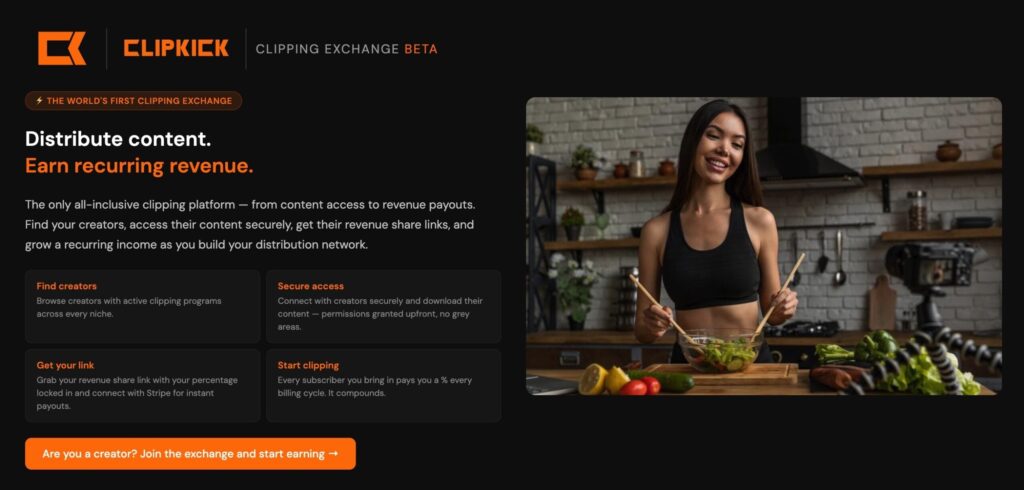
The Clipkick Clipping Exchange was built to solve both problems at once.

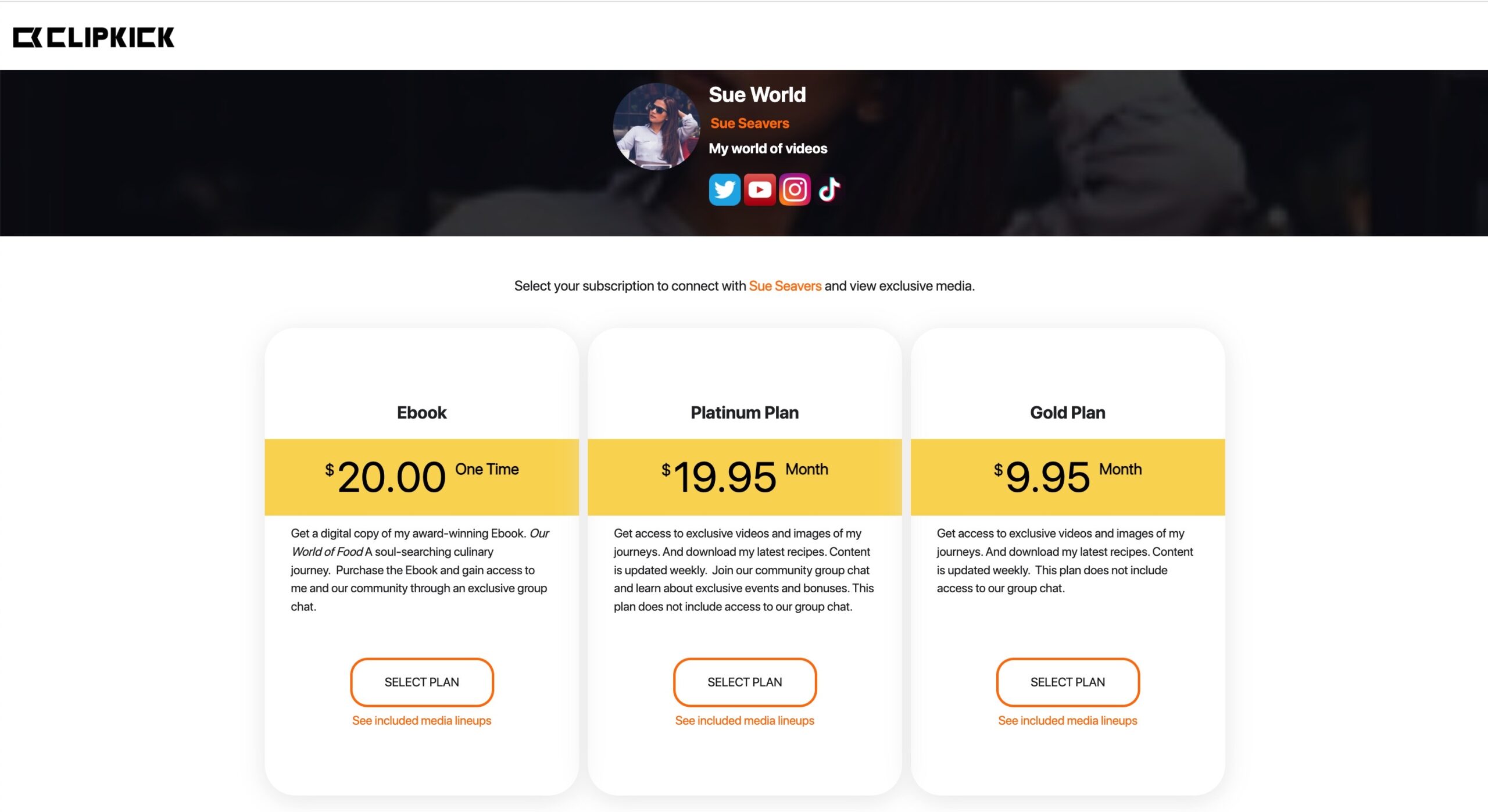
For creators, it is the first platform where they can list their clipping program in an organized directory, give approved clippers secure, permission-based access to their content vault, and have every clip posted drive traffic directly to their Clipkick paywall. Creators decide who clips their content. They set the terms. They keep control. One connection gives a clipper everything they need. One removal takes it all away.

For clippers, it is the first platform where they earn recurring revenue instead of a one-time view payment and secure, rights-controlled access to creator content and a personalized revenue share link, both controlled by a single connection token. One approval gives a clipper everything they need. One removal takes it all away. Every subscriber a clipper brings to a creator’s paywall pays them a percentage every billing cycle for as long as that subscriber stays active. The more creators a clipper works with, the more their income compounds. They are not starting from zero every month. They are building something.

How to Get Started With the Clipkick Clipping Exchange

Right now there are more clippers looking for creator programs than there are organized programs for them to join. That gap is the opportunity. The Clipkick Clipping Exchange gives creators a way to run a legitimate, organized clipping program for the first time, and gives clippers a place to find them.

If you are a creator who has been making great content without getting the views it deserves, get listed in the Clipkick Clipping Exchange for free. Use our AI plan builder to create your Clipkick paywall from scratch, or list your existing subscription platform like Kajabi or Teachable and connect with clippers who will drive traffic to your offer.

If you are a clipper, this is your opportunity to stop earning per view and start building recurring income that compounds every month.

The world’s first Clipping Exchange is open.

The Rise of Personal Media Subscription Platforms: The New Trend in Monetization


Subscription-based models have become a game-changer for creators looking to monetize their work. Unlike traditional platforms like YouTube, which rely heavily on ad revenue and require massive viewership to generate meaningful income, personal media subscription platforms empower creators to build reliable revenue streams with smaller, more engaged fan bases. These platforms make it easy to offer exclusive content, set up recurring subscriptions, and connect with supporters through tools like chat and personalized interactions. With enhanced security to protect against piracy and flexible subscription options, they allow creators to overcome the unpredictability of algorithms and ad-driven models, focusing instead on delivering value to their most loyal fans.

In this article, we’ll explore why subscription platforms are gaining popularity, how they benefit creators, highlight some of the top platforms, and discuss predictions for the future of this rapidly growing industry.

Why the shift is happening

The creator economy has been on an incredible rise in recent years, with spending on creator subscriptions skyrocketing. In 2022, the creator economy was valued at a whopping $104.2 billion, and experts predict it will double by 2027, reaching an estimated $208.4 billion. 

This growth is a clear sign that consumers are increasingly willing to pay directly for content rather than rely on ad-supported models.

It’s not just a niche trend—it’s part of a much larger subscription economy boom. Between 2018 and 2021, U.S. consumers increased their average annual spending on subscription services by $430, reflecting a 15% surge. By 2021, the typical consumer was spending about $273 per month on various subscriptions, a number that has likely continued to climb.

Some platforms are seeing especially massive gains. Take OnlyFans, for example—it saw its revenue jump by $217 million, reaching $1.3 billion by the end of 2022. Its user base has exploded, with creator accounts growing by 29% and fan accounts up by 28%, bringing the platform to over 4.1 million creators and 305 million fans. Payments to creators hit an astounding $6.6 billion, marking a $1 billion increase in just one year.

This rapid expansion in consumer spending on creator subscriptions signals a fundamental shift in how digital content is valued and monetized. Instead of chasing ad revenue, creators are now building direct relationships with their audiences, and fans are proving they’re more than happy to support them.

These statistics underscore the escalating consumer investment in creator subscriptions, reflecting a broader shift towards direct support for content creators and the growing prominence of the subscription-based model in the digital economy.

Creators are shifting away from ad-driven revenue models and embracing subscription-based platforms for several key reasons.

First, ad revenue has become increasingly unreliable. You need a lot of views to make money ad revenue, platforms like YouTube and Instagram view rates vary wildly, making it difficult for creators to predict their earnings. Even those with large followings often struggle to generate consistent income through ads alone.


Another major factor is algorithm unpredictability. Social media platforms frequently change their algorithms, making it harder for creators to reach their audience without paying for boosted posts. This means that even highly engaged followers might not see a creator’s content unless they actively seek it out.

Then there’s the issue of demonetization and content restrictions. Many platforms have vague and shifting policies on what content can be monetized. Creators in sensitive or niche categories often find their videos or posts demonetized with little explanation, cutting off a key source of revenue.

Perhaps the biggest driver of the subscription boom is consumer behavior. Audiences are more willing than ever to pay directly for exclusive content from their favorite creators. Services like Netflix and Spotify have conditioned people to see subscriptions as the norm, and they’re increasingly happy to support independent creators in the same way.

By moving to subscription platforms, creators gain more control, financial stability, and a direct relationship with their audience—a powerful alternative to the uncertainty of ad-based revenue.

How creators benefit


Subscription platforms are a game-changer for creators, giving them more control over their income and audience than ever before. Unlike the unpredictable world of ad revenue, subscriptions provide a steady, reliable income stream, allowing creators to focus on their craft without worrying about fluctuating payouts. Instead of hoping for viral hits to make ends meet, they can count on consistent support from their most dedicated fans.

Speaking of fans, subscription models create a much deeper connection between creators and their audiences. When someone pays for exclusive content, they’re more invested, engaged, and likely to interact. Many platforms even offer direct messaging, live Q&As, and behind-the-scenes content, strengthening the creator-fan relationship in a way that ad-driven platforms simply can’t.

Another huge advantage? Creative freedom. Since income isn’t tied to advertisers or algorithms, creators can focus on making content that truly resonates with their audience, rather than chasing trends for visibility. Plus, they own the relationship—there’s no middleman deciding who sees their content. Unlike social media platforms where algorithms determine visibility, subscription services allow creators to connect directly with their paying supporters, ensuring their content reaches the right audience every time.

Examples of top personal media subscription platforms

With so many platforms out there, choosing the right one depends on the kind of content you create. Some platforms cater to artists and writers, while others are built for video creators, educators, or musicians.

Here are some of the top creator subscription platforms and what they are best for:

clipkick-clipping-blog-9
  • Patreon– Best for artists, podcasters, and writers looking to offer exclusive content through tiered memberships.
  • OnlyFans– Best for creators who want to monetize video and photo adult content with built-in pay-per-view and tipping options.
  • Clipkick– all types of creators including performers, models, sports figures, podcasters, personal trainers, and music producers seeking a secure, safe for all users platform to share and monetize all types of media, communicate and build a loyal fan base.
  • Substack– Best for writers and journalists who want to monetize newsletters and long-form content through direct email subscriptions.
  • Uscreen– Best for video creators, who want to build a branded streaming service.
  • Podia– Best for educators and entrepreneurs looking to sell courses, memberships, and digital downloads in one place.

Each platform offers something unique, so choosing the right one depends on how you want to engage with your audience and the kind of content you create. Each of these platforms offers unique features, so creators need to choose based on their content type and audience.

Predictions for the Future

The creator subscription model is just getting started, and the future is full of exciting possibilities. As more creators embrace direct fan support, we’re likely to see new trends and innovations emerge.

For one, we can expect more niche platforms to pop up. While big names like Patreon and OnlyFans dominate now, specialized platforms for gaming, fitness, and education will likely gain traction. AI will also play a huge role, offering better content recommendations and personalized user experiences to keep subscribers engaged.

Security will be another major focus. As piracy concerns grow, platforms will introduce stronger encryption, watermarking, and content tracking to ensure creators can protect and profit from their work. Personal media platforms can also protect creator owned content from being ingested into AI databases without compensation. And with social media still being a huge traffic driver, we’ll probably see more seamless integrations with platforms like Instagram, TikTok, and YouTube, helping creators turn casual followers into paying subscribers.

But there’s also a challenge ahead—subscription fatigue. Consumers are already overwhelmed with paid memberships, from streaming services to Patreon pledges. Platforms that offer extra value, bundled content, or unique community experiences will be the ones that thrive in this competitive landscape.

Conclusion

The subscription model is here to stay, giving creators more control, financial independence, and stronger fan connections. While challenges like audience growth and discoverability remain, new platforms and features will continue to improve the landscape. Creators who embrace this shift early can secure long-term success and sustainability in the digital economy.

Sources:

  • WPBeginner: Creator Economy Statistics
  • SellCoursesOnline: Subscription Economy Statistics
  • Business Insider: OnlyFans Revenue Growth


Top 7 Creator Subscription Platforms For 2025


Subscription-based models
have become a game-changer for creators looking to monetize their work. Unlike traditional platforms like YouTube, which rely heavily on ad revenue and require massive viewership to generate meaningful income, personal media subscription platforms empower creators to build reliable revenue streams with smaller, more engaged fan bases. These platforms make it easy to offer exclusive content, set up recurring subscriptions, and connect with supporters through tools like chat and personalized interactions. With enhanced security to protect against piracy and flexible subscription options, they allow creators to overcome the unpredictability of algorithms and ad-driven models, focusing instead on delivering value to their most loyal fans.

In this article, we’ll compare the top 7 subscription-based personal media platforms for 2025, focusing on key features that matter most to creators. From the ability to support monthly subscriptions and stream video or audio content, to the types of files they can host, their security measures, ease of use, and the type of streaming interface they offer, this guide will help you find the platform that aligns with your goals. Whether you prefer a post-based interface like Patreon or OnlyFans or a playlist-style format like Clipkick or Uscreen, there’s a platform designed to suit your needs.

Patreon enables creators to build fan relationships with tiered subscriptions for exclusive content and perks.

Patreon is one of the most popular platforms for creators looking to monetize through subscriptions. It caters to a wide range of creators, from podcasters and writers to educators and artists, with an intuitive interface for setting up customizable subscription tiers. Patreon does not host video or audio content directly,  but does offer integrations with platforms like YouTube and SoundCloud make it easy to share multimedia.

Patreon offers secure payment processing and data protection, but media security relies on the external platforms used. Its interface is post-based, functioning like a traditional webpage for patrons to browse and access exclusive content.

Streaming Interface Type: Does not host video and audio content directly. Webpage post format, where content is accessed through posts. 

Strengths:

  • Seamless integration with multimedia platforms like YouTube and SoundCloud.


  • Flexible subscription tiers with customizable rewards.


  • User-friendly interface with easy subscription setup.


  • Community features like direct messaging.

Weaknesses:

  • Limited native hosting for video and audio content making content less secure and adding potential extra cost for hosting content externally.

  • Media security depends on external platforms.
Platform and transaction fees can reduce earnings.

Best for:
Artists, podcasters, and writers looking to offer exclusive content through tiered memberships, but are not that concerned about piracy and security.

OnlyFans allows creators to monetize their content through monthly subscriptions, pay-per-view options, and tipping. The platform offers  hosting and streaming video and audio content directly, making it good for multimedia creators.   Its interface is similar to Patreon’s, with a post-based format where subscribers access content on the creator’s pages.

Because of OnlyFans focus on adult content, they do not offer mobile apps in the app store like other platforms and is only available in commercial web browsers. Security features like watermarking and two-factor authentication help protect content from piracy. However, its association with certain niches and adult content may not suit all creators.

Streaming Interface Type: Webpage post format, allowing subscribers to browse posts that can contain native media content. 

         Strengths:

  • Direct upload and streaming capabilities for video and audio.
  • Multiple monetization options, including pay-per-view and tips.
  • Strong security features, including watermarking and two-factor authentication.
  • Intuitive interface for creators and subscribers.

           Weaknesses:

  • Public perception may deter some creators as it focused on adult content.
  • Does not provide mobile applications due to adult content restrictions in app stores.
  • Limited discoverability features; creators must drive traffic themselves.
  • High platform fees can impact earnings.

Best for:
Creators who want to monetize video and photo adult content with built-in pay-per-view and                tipping option.

Clipkick offers creator-focused features with secure cloud storage, subscriptions, tipping, and monetization options.

Clipkick stands out for its robust security and versatility, supporting over 100 file types, from videos and audio to documents. It’s designed for creators prioritizing control over their content, with features like encryption, secure streaming, and prevention of unauthorized downloads. CLIPKICK is one of the simplest to use: Create secure media playlists with video, images, audio, and documents, then allow subscribers to access those playlists with a subscription.

Its subscription management tools include paywalls and tipping functionality, while its patented streaming interface has a unique playlist format, similar to Spotify or Netflix, allowing for seamless, curated playback of any kind of content, including video, audio, images, documents and external links. CLIPKICK also has secure chat features to engage with your audience and build a community by letting subscribers communicate in groups.

CLIPKICK is a good alternative to OnlyFans if one wants to create an engaging subscription fan site with streaming video, audio, images and books but doesn’t want to be associated with adult content. 

Streaming Interface Type: Playlist-based format, offering a patented universal media display technology that allows for curation of all different file types including video, audio, images, documents and links in one swipeable  player.

            Strengths:

  • Simple to use: Create media playlists called lineups with any kind of media, then offer secure connections to the content through paywall subscriptions.
  • Supports over 100 file types, ideal for multimedia creators.
  • Comprehensive tools for subscriptions, paywalls, and tips.
  • Advanced security features, including encryption and anti-piracy measures and two factor authentication.
  • Best in class cloud features stores all of your original files saving space on your devices.
  • Spotify-like streaming experience with playlists and lineups.

    Weaknesses:

  • Limited discovery features; creators must attract their audience.
  • Invitation-only format increases security but can make it harder for new users to join.

Best for:
All types of creators including performers, models, sports figures, podcasters, personal trainers, and music producers seeking a secure, safe for all users platform to share and monetize all types of media, communicate and build a loyal fan base.

Substack is a go-to platform for writers and podcasters seeking to monetize their content through newsletters and subscriptions. Its clean, simple interface makes it easy to create and distribute content via email, with flexible options for monthly or yearly subscriptions.

Substack is not focused on multimedia streaming but does support podcast hosting. Its email-based content delivery offers a unique, direct connection to subscribers, but it lacks the dynamic streaming interfaces of other platforms.

Streaming Interface Type: Email-based content delivery, with limited streaming capabilities.

      Strengths:

  • Clean and simple interface tailored for writers and podcasters.
  • Flexible subscription setup with options for monthly or yearly plans.
  • Strong email-based distribution system for direct audience engagement.
  • SSL encryption ensures data security.

    Weaknesses:

  • Primarily text-focused, with limited multimedia support.
  • Few piracy prevention tools.
  • Lacks interactive features like chat or community-building tools.

Best for:
Writers and journalists who want to monetize newsletters and long-form content through direct email subscriptions.

Uscreen is a powerful platform for creators seeking to monetize video content through subscriptions. It offers high-quality video hosting and live streaming, along with tools to build and manage subscription tiers. The platform’s interface is customizable, allowing creators to create branded streaming services similar to their own Netflix-style platform. Security is a priority, with DRM technology to prevent unauthorized access or piracy.

Uscreen is built specifically for selling pre-recorded or live video content, and is not the best option for developing a fan site with varied types of media.

Streaming Interface Type: Customizable, Netflix-like branded streaming service.

       Strengths:

  • High-quality video hosting and live streaming capabilities.
  • Advanced security with DRM technology to prevent piracy.
  • Customization options for branding and service personalization.
  • Comprehensive tools for managing subscriptions.

    Weaknesses:

  • Steeper learning curve for creators new to advanced tools.
  • Limited to video content and not designed for other types of content like audio, images, or pdfs.
  • Premium pricing may deter smaller or new creators.
  • Limited community engagement tools.

Best for:
Video creators, who want to build a branded streaming service.

Ko-fi is an accessible platform ideal for creators seeking simple monetization options. It offers one-time donations and monthly memberships, with no platform fees for free plans (other than payment processing). Its interface is minimalist, with no native streaming; creators share external links to their content. 

This simplicity makes it ideal for beginners but less suitable for creators requiring dynamic streaming interfaces or video, audio, and printed materials.

Streaming Interface Type: No native streaming; relies on external links. 

       Strengths:

  • Extremely user-friendly, with a minimalist design.
  • Flexible monetization through one-time donations or memberships.
  • Ideal for creators seeking simplicity.

    Weaknesses:

  • No native hosting for video or audio content; relies on external links.
  • Few piracy prevention tools.
  • Not suited for creators with large-scale multimedia needs.

Best for:
Creators who want a simple way to receive one-time donations, memberships, and commissions without platform fees.

Podia is an all-in-one platform that combines subscription services with tools for selling courses, digital downloads, and webinars. Podia supports a variety of file types however has so many features some might find it complicated to use. It also lacks advanced piracy prevention features and discovery tools.

Podia is a robust professional product that is appropriate for selling digital products, especially courses, but less of a fan subscription experience for entertainment purposes than other personal media subscription services.


Streaming Interface Type: Set up well for online course delivery.

             Strengths:

  • Combines subscriptions with options for courses and digital downloads.
  • Supports a wide range of file types.
  • SSL encryption ensures secure transactions and data protection.

    Weaknesses:

  • Robust feature set may be complicated for people who what a simple fan subscription experience.  Limited discoverability tools; creators must promote content independently.
  • Premium pricing may deter smaller creators 

Best for:
Educators and entrepreneurs looking to sell courses, memberships, and digital downloads in one place.

Conclusion

Choosing the right platform for subscription-based offerings is critical for creators looking to grow their audience and secure a steady income. Each of the platforms highlighted here offers unique features tailored to different needs, from Patreon’s community-focused post-based format to Uscreen’s customizable streaming service. For creators who prioritize content security and versatility, Clipkick’s patented playlist-based streaming interface provides an exceptional way to deliver curated content of any type while maintaining control over their work.

Ultimately, the best platform will depend on your content type, audience, and monetization goals. Whether you value interactive engagement, ease of setup, or advanced streaming interfaces, the evolving landscape of personal media platforms offers tools for all creators to succeed. As subscription models continue to grow in popularity, creators now have more options than ever to connect with their fans and thrive in their creative endeavors.