



Short-form video has taken over the internet. The short-form video platform market reached $40.58 billion in 2024 and is projected to grow to $193.91 billion by 2033. YouTube Shorts generates over 200 billion daily views. TikTok has 1.59 billion monthly active users. And sitting right in the middle of this explosion is a profession most people have never heard of: the content clipper. One operator alone now runs a network of roughly 40,000 freelance clippers, and a single campaign for streamer Adin Ross produced 430 million views across 11,000 videos made by 520 separate clippers. The money flowing into this space is real, it is growing fast, and it is just getting started.
What Is Content Clipping?
Clipping is the practice of taking long-form content, a podcast, a YouTube interview, a livestream, cutting it into short, engaging clips, and distributing those clips across TikTok, Instagram Reels, and YouTube Shorts. Clippers do not create original content. They do not need their own audience. They take existing content from creators and brands and turn it into short-form gold.
How Much Are Clippers Making?
The range is wide. Clippers earn anywhere from $500 to $50,000 per month depending on their volume, niche, and strategy. Beginners earning $200 to $500 in their first month is realistic. Intermediate clippers working 15 or more hours per week commonly earn $2,000 to $8,000 per month. Top performers report $10,000 to $30,000 per month. Business Insider reported that some top-performing elite clippers are now offered monthly retainers ranging from $500 to $1,500 in addition to performance-based pay. The barrier to entry is low. Most of those clippers are regular people with a laptop, an AI tool, and a few social media accounts.

The Problem With Every Major Clipping Site Today
Here is where it gets interesting. The clipping industry has a structural problem that nobody has solved until now.
For clippers, every major clipping site today pays per view and none of them provide secure, rights-controlled access to creator content. That means when you stop posting, you stop earning. You can spend weeks building a distribution network for a creator, generate hundreds of thousands of views, and walk away with a one-time CPM payment. Most sites pay between $1 and $5 per 1,000 verified views. The income is real but it does not compound. It does not build. The moment you take a break, the money stops.
The content problem runs just as deep. Without secure access to source material, clippers are left scraping content haphazardly from around the web, downloading YouTube videos, grabbing clips from public Instagram posts, and piecing together whatever they can find. There is no organized system, no permission, and no relationship with the creator whose content they are distributing.
For creators, the problem runs just as deep. They spend months, sometimes years, making great content but the algorithm is unpredictable, paid advertising is expensive, and growing an audience organically on a single account takes forever. Most creators are stuck. Their content is good but nobody is seeing it.

Enter the Clipping phenomenon.
Clipping already happens everywhere on the internet without their permission, their knowledge, or any benefit to them. Anyone can take a clip from a YouTube video, post it on TikTok, and rack up millions of views. The person posting those clips grows their own following, earns platform revenue through TikTok and YouTube’s creator funds, and in some cases adds their own affiliate links to profit further. The original creator whose content made all of this possible sees none of it. No credit, no revenue, no control. And because the content is publicly available, there is very little practical recourse.
The only way to run an organized clipping program today is through informal arrangements, Discord servers, and third-party sites that were not built for individual creators. There is no organized, secure way for a creator to manage their own clipping network, control who gets access to their content, and tie that distribution directly to measurable revenue growth.
Introducing the Clipkick Clipping Exchange
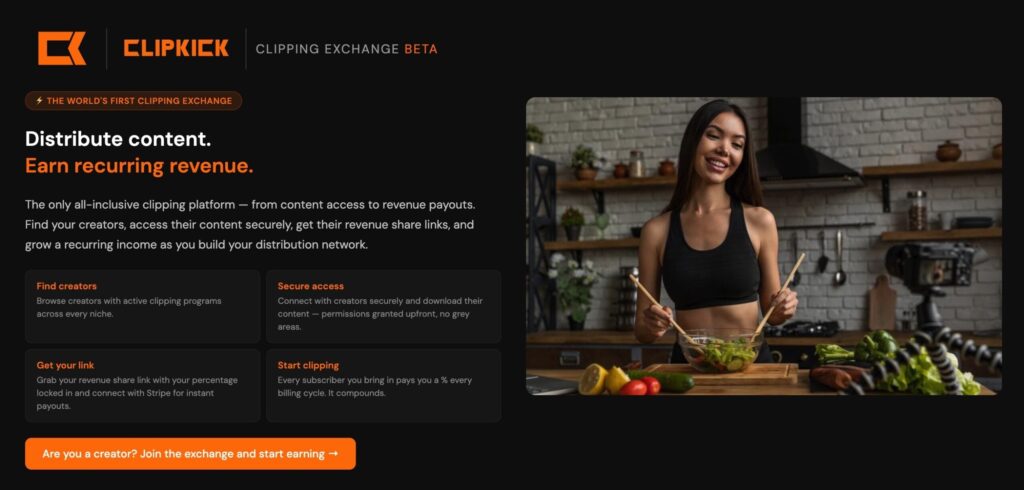
The Clipkick Clipping Exchange was built to solve both problems at once.
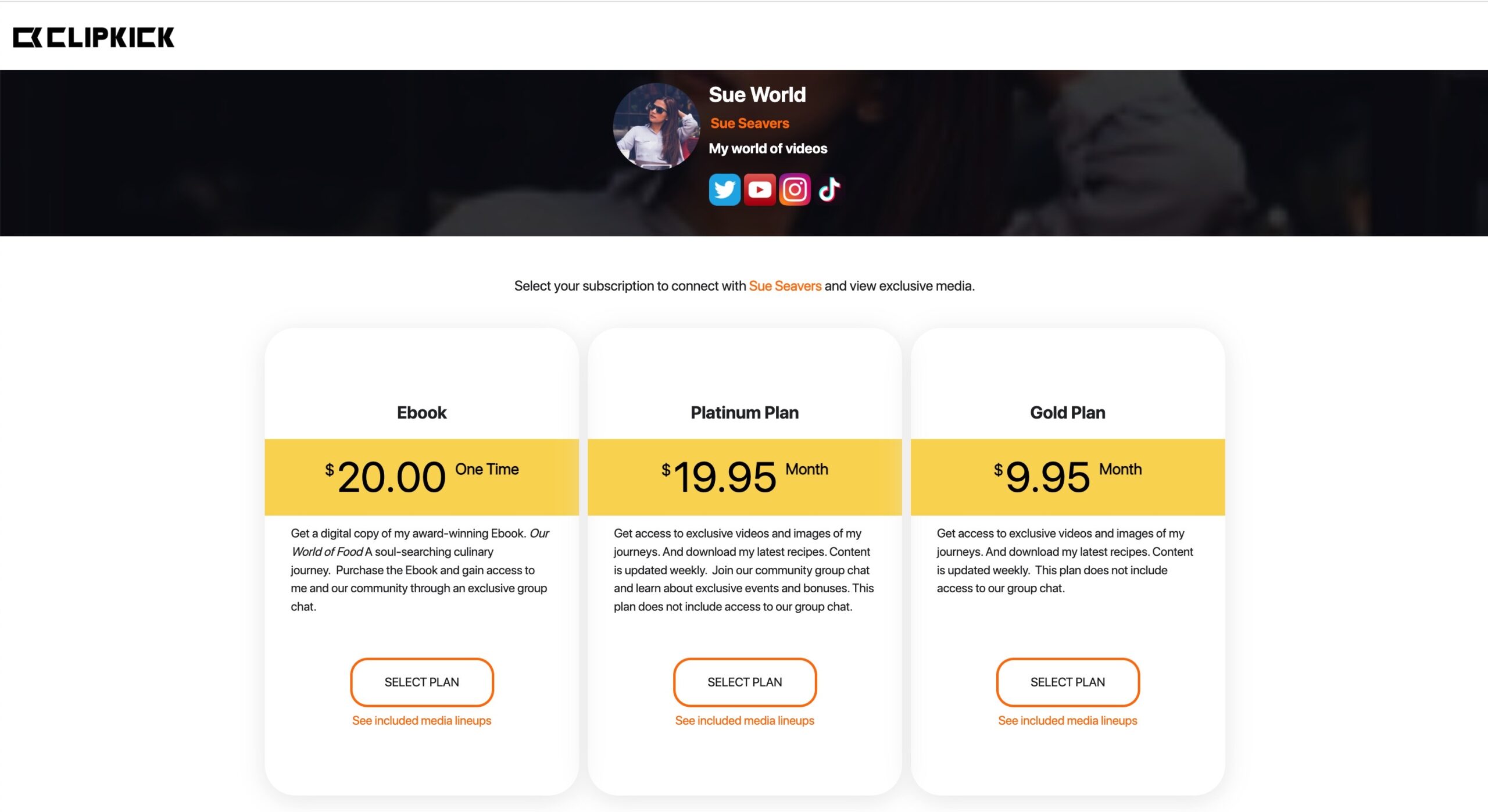
For creators, it is the first platform where they can list their clipping program in an organized directory, give approved clippers secure, permission-based access to their content vault, and have every clip posted drive traffic directly to their Clipkick paywall. Creators decide who clips their content. They set the terms. They keep control. One connection gives a clipper everything they need. One removal takes it all away.
For clippers, it is the first platform where they earn recurring revenue instead of a one-time view payment and secure, rights-controlled access to creator content and a personalized revenue share link, both controlled by a single connection token. One approval gives a clipper everything they need. One removal takes it all away. Every subscriber a clipper brings to a creator’s paywall pays them a percentage every billing cycle for as long as that subscriber stays active. The more creators a clipper works with, the more their income compounds. They are not starting from zero every month. They are building something.
How to Get Started With the Clipkick Clipping Exchange
Right now there are more clippers looking for creator programs than there are organized programs for them to join. That gap is the opportunity. The Clipkick Clipping Exchange gives creators a way to run a legitimate, organized clipping program for the first time, and gives clippers a place to find them.
If you are a creator who has been making great content without getting the views it deserves, get listed in the Clipkick Clipping Exchange for free. Use our AI plan builder to create your Clipkick paywall from scratch, or list your existing subscription platform like Kajabi or Teachable and connect with clippers who will drive traffic to your offer.
If you are a clipper, this is your opportunity to stop earning per view and start building recurring income that compounds every month.
The world’s first Clipping Exchange is open.